
Books That Teach Kids Decision-Making (Ages 3–8): An Honest Guide
Ask the internet for books that teach kids decision-making and you get long, undifferentiated lists — sixty titles, no indication of which one suits a stubborn four-year-old versus a seven-year-old who agonises over everything.
This is a shorter list, organised by the thing each book actually teaches. Some of these are interactive. Most are ordinary picture books, and several are better written than anything the personalized-book industry (ours included) has produced.
A note on where we stand: we make personalized choose-your-own-adventure books, so we have an obvious interest here. We have put our option in its own section near the end, sized honestly. The rest of this list is books we did not make.
First, what makes a decision-making book work
A book cannot teach a child to decide. What it can do is make the invisible part visible — the link between choosing and what happens next — and give a child a low-stakes place to notice it.
That gives you a simple test for any book in this category:
Is the choice real? Does the story show a genuine fork, or does it just assert that good children share? Assertion is a lecture with pictures.
Is the consequence concrete? Young children reason from what they can picture. "Everyone would be sad" is abstract. A beach buried in litter is not.
Is there room to be wrong? Books where the character only ever chooses well leave nothing to think about. The useful ones let a mistake play out.
We wrote about the underlying mechanism in more depth in how personalized books teach kids decision-making, and about the interactive format specifically in why letting kids choose actually matters.
Books where your child makes the call
What Should Danny Do? — Adir and Ganit Levy, illustrated by Mat Sadler
The standard-bearer, and deservedly the one that turns up on nearly every teacher's list. Danny is a superhero-in-training whose power is "the power to choose." At each turning point the reader picks what Danny does, and the paths lead to nine different endings.
What makes it work is the structure: a child who picks badly does not get a scolding, they get a worse day — and then they can go back and try the other branch. The choice-and-consequence link stops being a rule and becomes something they discovered.
Ages 4–8. There are sequels — What Should Danny Do? School Day and What Should Darla Do? — with the same mechanic in different settings.
This or That? A Story About Choosing — Kell Andrews, illustrated by Hector Borlasca
For the child who cannot decide at all. Alexander dithers so long over a Halloween costume that he ends up a pumpkin; he dithers over what to wear and misses the bus. The turn comes at his birthday, when he asks for a sundae with everything and realises he only wanted chocolate swirl.
It is the rare book aimed at indecision rather than misbehaviour, and it does not resolve by telling Alexander to be decisive. He works out his own style — slower than his father, faster than his mother. If you have a child who freezes when offered options, this is the one.
Ages 5–8.
Books about consequences and ripple effects
What If Everybody Did That? — Ellen Javernick, illustrated by Colleen Madden
Structurally clever in a way that suits how young children think. A boy commits small thoughtless acts — feeding popcorn to zoo bears, dropping a can from a car window, interrupting story time — and each time an adult asks the title question. The left page shows the small act; the right page shows the world where everyone does it.
That side-by-side layout does the work. It converts an abstract moral argument into a picture a five-year-old can hold in their head.
Ages 4–8.
Teach Your Dragon to Understand Consequences — Steve Herman
Part of a long series that uses a pet dragon as the stand-in for the child's own behaviour, which spares a sensitive kid the feeling of being lectured about themselves. Straightforwardly about small actions leading to outsized outcomes, good and bad. Less literary than most of this list; useful precisely because it is direct.
Ages 4–7.
Books about wanting everything
Betty Bunny Wants Everything — Michael B. Kaplan, illustrated by Stéphane Jorisch
Betty Bunny fills a shopping cart with toys and is told she may have one. She cannot do it, melts down, and goes home with nothing — and then her family helps her work out how to choose on a second trip.
This is the wants-versus-needs book that does not moralise. Betty is genuinely funny and keeps trying to find a loophole, which is exactly what real children do. It also does something most books in this category avoid: it lets the meltdown happen rather than skipping to the lesson.
Ages 3–6.
Books about deciding when everything looks good
88 Instruments — Chris Barton, illustrated by Louis Thomas
A boy must pick one instrument and is overwhelmed by the options. It treats indecision as a reasonable response to genuine abundance rather than a character flaw, and lands on choosing by working out what you actually want rather than by elimination. Preschool to grade 2.
The Favorite Book — Bethanie Deeney Murguia
About the act of evaluating and picking a favourite — smaller in scope than the others here, and a good first step for a child who is not ready for consequence-heavy stories. Preschool to grade 2.
Books about owning the choice you made
Lilly's Purple Plastic Purse — Kevin Henkes
Still the best book on this list, decision-making aside. Lilly adores her teacher until he confiscates the noisy purse she will not stop showing off. Furious, she draws him something cruel — and then has to sit with having done it.
What sets it apart is that the regret is Lilly's own. Nobody tells her she was wrong; she works it out, and then has to do the harder thing and repair it. That second step — the choice you make after the bad choice — is the part most books in this category skip entirely.
Ages 4–8.
I Want My Hat Back — Jon Klassen
A bear searches for his hat, meets a rabbit wearing it who flatly denies everything, and eventually works out what happened. Worth knowing before you buy: the ending is dark, deadpan and left to inference — the bear gets his hat back and the rabbit is not seen again.
Some children find this hilarious and some find it upsetting, so you know your child best. For the ones who find it funny, it is a sharp, wordless-in-places lesson about lying and about the moment you realise you have been lied to.
Ages 4–8.
Books about choosing together
I Voted: Making a Choice Makes a Difference — Mark Shulman, illustrated by Serge Bloch
Starts with choosing between apples and oranges and builds toward group decisions and elections. The useful part is not the civics; it is that it covers what happens when you are outvoted — the disagreement, and being on the losing side of a fair choice, which almost nothing else at this age level addresses.
Preschool to grade 2.
Where a branching personalized book fits
This is our category, so weigh it accordingly.
Every book above has the child watching someone else decide — Danny, Alexander, Betty, Lilly. That distance is often a feature, especially for a child who would bristle at a story that was too obviously about them.
A branching personalized book removes the distance. In a TinyTales story your child appears as the hero from a single photo, and at each turning point they choose what happens next: tell the truth or hide it, keep going or ask for help. The consequence follows their choice, and they can turn back and take the other path.
What that adds is practice as themselves rather than observation of someone else. What it does not do is replace anything on this list. It is one story. Lilly's Purple Plastic Purse is better written than anything we will publish this year, and costs a fraction of what a personalized hardcover does.
The honest positioning: if you are building a shelf, build it from the books above. If you already have that shelf and want the thing it cannot do — your child in the hero's seat, deciding — that is the gap we fill.
The caveat nobody in our industry writes down
A personalized book is a special object. Special objects are read differently: more ceremonially, often less often, and rarely at the volume that actually builds a reader.
The books on this list are cheap, borrowable from any library, and survive being read to pieces. If you buy one thing after reading this page, buy one of those. We would rather be the second thing you buy than the reason you bought nothing.
How to actually read these with a child
Pause before the outcome. The single highest-value habit. Stop at the fork, ask what they think happens, let them commit — then turn the page. Prediction is where the thinking lives.
Do not steer. If they pick the choice you would not, let it play out. A consequence they watched unfold beats one they were warned about.
Re-read the other branch. For interactive books especially, the second reading is where the comparison happens. That is the point of the format; skipping it wastes it.
Let them narrate. Ask what the character should do next and let them answer in their own words before you read on.
Do not close with a moral. The instinct to summarise — "so what do we learn?" — reliably converts a story back into a lecture. If the book worked, they already know.
The bottom line
Most books sold as decision-making books are books about good behaviour, which is a different and much less useful thing. The ones worth your money show a real fork, a concrete consequence, and room to be wrong.
Start with What If Everybody Did That? if consequences are the gap, What Should Danny Do? if you want the child doing the deciding, This or That? if they freeze, and Lilly's Purple Plastic Purse if the hard part is what comes after a bad choice.
Then, if you want your child to practise deciding as themselves rather than as Danny, that is what we build.
See your child in the story
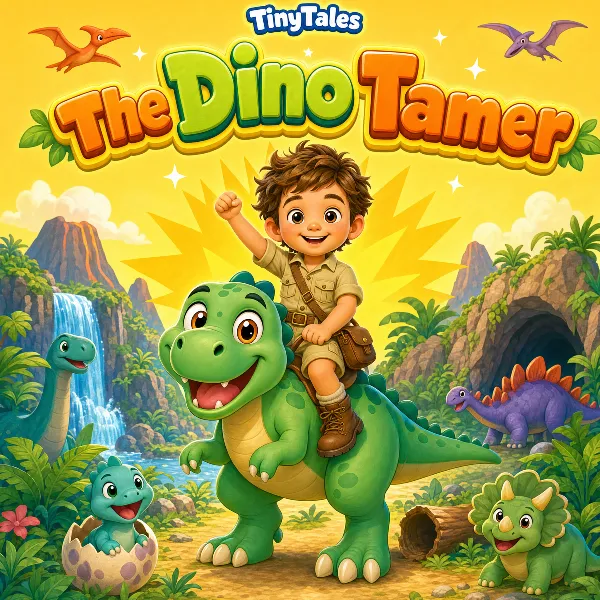
Upload one photo and see The Dino Tamer with their real face in the pictures, before you pay.
Preview their book freeFrequently asked questions
What are the best books for teaching kids about choices and consequences?
For ages 3–8, the most useful ones fall into a few groups. For consequences, What If Everybody Did That? by Ellen Javernick makes the ripple effect visible on every spread. For practising the decision itself, What Should Danny Do? by Adir and Ganit Levy lets the child pick Danny's actions across nine possible endings. For a child who freezes when asked to choose, This or That? by Kell Andrews is about finding your own decision-making style. For owning a bad choice, Lilly's Purple Plastic Purse by Kevin Henkes is still the standard.
What age should you start reading decision-making books?
In our experience, around age 3 for the simplest ones, where the choice is between two clear options and the consequence is immediate and concrete. Books built on ripple effects — the what-if-everybody idea — tend to land better a couple of years later, once a child starts following cause and effect across a whole story. Every child is different; below 3 we'd focus on naming feelings rather than weighing options.
Do interactive 'choose your own adventure' books work better than regular picture books?
Not automatically, and it would be dishonest to claim otherwise. A brilliantly written linear picture book beats a mediocre interactive one every time. What interactive books add is practice: instead of watching a character decide, the child decides, then sees the result. That is a genuinely different activity, and it is the reason the format keeps showing up on teacher and librarian lists — not a guarantee of a better book.
How do I actually talk to my child about the choices in these books?
Pause before the outcome, not after. Ask what they think will happen, let them commit to a guess, then turn the page. The gap between predicting and finding out is where the thinking happens. Avoid steering them to the 'right' answer — a child who picks the messy option and watches it go wrong has learned more than one who was told.
Are personalized books a good way to teach decision-making?
They can be, if the book genuinely branches rather than just swapping in a name. The advantage is that the child is the one deciding, as themselves. The honest caveat is that a personalized book is one book — it is a special addition to a shelf, not a replacement for the classics on this list, several of which are better written and cost a fraction as much.
Where does TinyTales fit on this list?
In the interactive group, and it is fair to say we are biased about it. TinyTales makes choose-your-own-adventure books where your child appears as the hero from one photo and their choices change what happens next. It is the practice-it-yourself option rather than a replacement for What Should Danny Do? or Lilly's Purple Plastic Purse — those are excellent books and cost far less.