
Personalized Bedtime Books That End Bedtime Battles
Every parent knows the bedtime script by heart, because it repeats every night. Teeth are brushed. Pajamas are on. And then — one more drink of water, one more story, one more trip to check the closet, a small negotiation over whether the door stays open exactly this much. The day that started at 6 a.m. now has a long tail, and it is made entirely of stalling.
Bedtime battles are one of the most searched-for, least-talked-about parts of raising a small child. They're exhausting precisely because they happen when you have nothing left. And they are stubborn, because a child stalling at bedtime is almost never being "bad" — they are doing something very human: resisting the moment they have to let go of the day, the light, and you.
This is an honest guide to whether a personalized bedtime book can help with that, and how to use one well. It won't promise a book will fix your nights — nothing that comes in the mail can do that. But there is a real, non-magical reason a story that stars your child can make the last half hour calmer, and it's worth understanding before you spend money on one.
Why bedtime becomes a battle in the first place
It helps to name what's actually happening. For most young children, bedtime resistance comes down to two things: control and fear.
Control, because sleep is the one thing you cannot make a child do. You can dim the lights and lie down beside them, but the last step — actually letting go into sleep — is theirs alone. A child who has been told what to do all day often makes their stand at the exact moment they sense they're being asked to surrender the most.
Fear, because the dark is genuinely bigger and stranger to a three-year-old than to us. The closet that was just a closet at noon is a different object at 8 p.m. "There's nothing to be scared of" is true, and it almost never works, because the feeling isn't built on facts.
Any tool that helps at bedtime — including a book — works by gently addressing one or both of those. That's the lens to judge a bedtime book through: does it hand the child a little control, and does it help them face the dark instead of arguing them out of it?
What the sleep research actually supports (and what it doesn't)
Here is the part most bedtime-book marketing skips, so let's be precise.
A consistent bedtime routine — the same calming steps, in the same order, at about the same time — is one of the best-supported, lowest-effort things you can do for a young child's sleep. According to the Sleep Foundation, children who follow a bedtime routine tend to go to sleep earlier, take less time to fall asleep, sleep longer, and wake less during the night; the page cites the widely-referenced Mindell et al. (2009) study of young children. The Sleep Foundation also lists reading a book among the activities shown to have beneficial effects on sleep.
Read that carefully, because it matters for honesty: the evidence is for the routine, and for reading as part of that routine. It is not evidence that any particular book — personalized or not — improves sleep on its own. There is no credible study showing that printing your child's name in a story makes them sleep better. If you see a claim like that with a percentage attached, treat it with suspicion.
So the honest mechanism is this: a book earns its place at bedtime by being a reliable, calming step in the routine — the signal that the day is closing — and, if it's the right book, by helping with control and fear. Personalization doesn't change the sleep science. It changes how much your child wants to take that step.
Where a personalized bedtime book genuinely helps
If the routine is the medicine, personalization is what makes a child swallow it willingly. Two mechanisms are doing the work.
1. "This story is about me" turns a chore into a ritual they ask for. Children identify most strongly with a hero who looks and is named like them. When your child is the character in the book, "time for bed" quietly becomes "time for my story" — and a step they used to fight becomes one they request. That's not a sleep breakthrough; it's motivation, and at 8 p.m. motivation is worth a great deal.
2. The right story lets them rehearse being brave, instead of being told to be. This is where the plot matters more than the personalization. A bedtime book that helps with fear isn't one that insists there's nothing scary — it's one where a child just like yours meets the dark (or the monster, or the shadow on the wall) and does something small and brave about it. Watching "a kid like me" befriend the thing under the bed does more than any reassurance from the doorway.
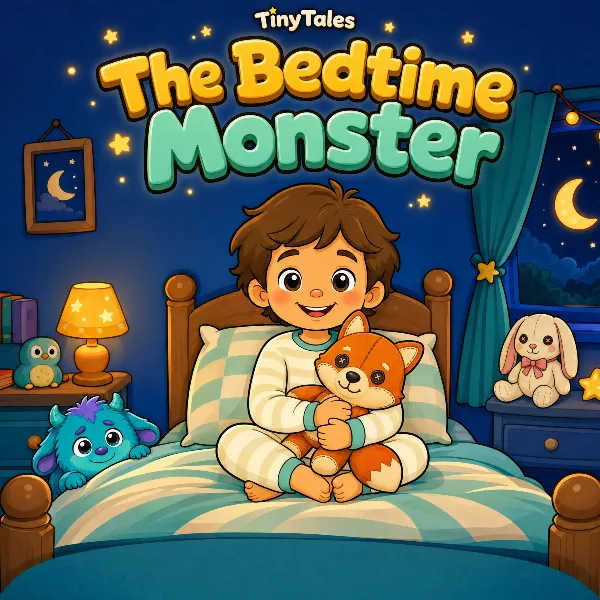
TinyTales' bedtime story is built on exactly this idea: the child is the hero who discovers the "monster" is lonely, not scary, and gives it a name and a friend. Your child becomes that hero through one uploaded photo — appearing photo-real in every scene, not turned into a generic cartoon — so the brave kid befriending the dark is unmistakably them. (Here's how the personalization works if you're curious about the mechanics.)
3. A choose-your-own-adventure book hands back control — the exact thing bedtime takes away. This is the piece most bedtime books don't have. If the story lets your child make choices — should the hero peek under the bed or turn on the nightlight first? — they spend the wind-down making decisions rather than losing them. For a child whose bedtime resistance is really a control standoff, that small handover can defuse the whole thing. We've written more about why making choices in a story matters and how branching stories teach decision-making if you want the longer version.
If your child's bedtime worries run deeper than ordinary stalling — real, persistent anxiety — our gentle guide to books for anxious and sensitive children goes further, and is careful about when a book isn't enough.
Honest comparison: the personalized bedtime options
There are more personalized bedtime books than there used to be, and they're genuinely different tools. Here's a fair map, with the trade-offs stated plainly. All competitor details below are as of July 2026 — brands change prices and features, so verify before buying.
| Approach | How your child appears | Best for | The honest trade-off |
|---|---|---|---|
| Name-insertion board & picture books (e.g. I See Me! "Goodnight Little Me") | Name printed in the text and sometimes the art; an illustrated child, not your child | Babies and young toddlers; a first keepsake | Cheapest and lovely for little ones, but the "hero" doesn't actually look like your kid |
| Illustrated character books (e.g. Wonderbly "Bedtime For You") | A customizable illustrated character (skin tone, hair), name woven through the rhyme | Toddlers who like a cozy, rhyming lullaby | Warm and well-made; character is a chosen illustration, not a likeness of your child |
| Photo-real, choose-your-own-adventure (TinyTales) | Your actual child, from one photo, as the photo-real hero in every scene, making the choices | Ages ~3–6 who stall, negotiate, and fear the dark | Costs more than a name-insertion board book; the payoff is real likeness plus agency |
A few specifics to keep it concrete and honest:
Wonderbly's "Bedtime For You" is a hardcover rhyming bedtime book recommended for ages 0–4, personalized with your child's name and a chosen illustrated character, starting at $34.99 (as of July 2026). It's a genuinely lovely, calm lullaby book — if what you want is a soft, cuddly countdown to sleep for a very young child, it does that beautifully. What it doesn't do is make your child appear; the character is an illustration you customize, not their face.
Name-insertion bedtime books like I See Me!'s long-running "Goodnight Little Me" put your child's name front and center and are often the most affordable, most toddler-appropriate choice (as of July 2026). Credit where it's due: for a one- or two-year-old, a short, rhyming, name-in-the-story board book may be the better pick than anything more elaborate. Simple and repetitive is soothing.
TinyTales' photo-real approach is aimed at a slightly older child — roughly 3 to 6 — for whom the bedtime problem has become a nightly negotiation. The differentiator is honest and specific: your child genuinely sees themselves being the brave one, and (uniquely) makes the choices in a branching story. That combination is what a control-and-fear standoff responds to.
The takeaway isn't "the expensive one is best." It's match the tool to the child. Under two, keep it simple, cheap, and rhyming. Three to six and battling? That's exactly when likeness plus agency earns its keep.
How to actually use the book so it helps
Buying the book is the easy part. Making it work is about how you fold it into the routine.
- Make it the same step, every night. The book should always sit in the same slot — after teeth and pajamas, before lights-out. Predictability is the active ingredient; the book is the signpost that says "we're near the end now."
- Keep the light and the voice low. The last stretch should be less stimulating, not more. Read a little slower and quieter than feels natural. If you're using a digital version, dim the screen all the way and read it before final lights-out — the point of a bedtime book is no bright light in a dark room.
- Let them steer where you can. If the book has choices, let your child make them — even the "wrong" ones. That's the control handover doing its job. If it doesn't, let them turn the pages and set the pace.
- Don't over-read it — but do re-read it. Repetition is soothing at bedtime; the tenth reading of the same story is a feature, not a failure. But keep the number of books fixed ("we read one, then lights out") so the book doesn't become a new negotiating chip.
- Let the story do the reassuring. When the fear comes up, resist "there's nothing to worry about." Point at the page instead: look how they figured out the monster was just lonely. A brave character on the page persuades where a tired parent in the doorway can't.
The honest bottom line
A personalized bedtime book is not a sleep cure, and you should be wary of anything sold as one. What it can be — used well — is the calm, wanted anchor at the end of a consistent routine, and a small nightly rehearsal of the two things a bedtime battle is really about: feeling in control, and facing the dark.
If your child is a baby or young toddler, a simple rhyming name-insertion book is often the smartest buy. If you've got a three-to-six-year-old who stalls, negotiates, and fears what's under the bed, a story where they are the photo-real hero — and get to make the brave choices themselves — is worth the difference. Either way, the book is only ever one step. The routine around it, and you reading it, are what actually turn the lights out.
When you're ready to look, TinyTales' bedtime story is built for exactly the battling-at-bedtime child, and you can browse the whole collection — including problem-solving stories like the getting-dressed adventure and the teeth-brushing quest — if bedtime isn't the only nightly standoff at your house. For the full picture of how personalized books work and who they're for, start with our complete guide to personalized children's books.
See your child in the story
Upload one photo and see Bedtime Monster with their real face in the pictures, before you pay.
Preview their book freeFrequently asked questions
Can a bedtime book really stop bedtime battles?
Not by itself — and any product that promises to is overselling. What a good bedtime book does is give the last stretch of the day a calm, predictable anchor. A consistent wind-down routine (bath, pajamas, a book, lights low, same order every night) is associated with children falling asleep faster and waking less during the night, and reading is one of the activities sleep researchers list as part of a healthy routine. The book is one reliable step in that chain; the routine and the calm adult reading it are what actually settle a child.
Why would a personalized book help at bedtime specifically?
Two reasons. First, children identify most strongly with a hero who looks and is named like them, so a book where your child is the brave character can turn 'time to sleep' into 'time for my story.' Second, a bedtime struggle is usually about a child not feeling in control at the exact moment they're asked to give up control. A story where they are the capable hero — and, in a choose-your-own-adventure book, one where they make the choices — hands a little of that control back.
What age is a personalized bedtime book good for?
Roughly ages 2 to 8, with the sweet spot around 3 to 6 when bedtime resistance peaks and a child is old enough to recognize themselves as the hero. For babies and very young toddlers, a short, rhyming name-insertion board book is often the better, cheaper fit. For a 3-to-6-year-old who negotiates, stalls, and fears the dark, a story where they conquer exactly that fear does more.
Isn't a screen or an app easier than a book at bedtime?
A printed book has one real advantage at bedtime: no glowing screen. If you want the interactivity of a choose-your-own-adventure story without a bright display in a dark room, a digital book read on a dimmed device before lights-out, or simply a printed copy, keeps the wind-down calm. The goal of the last half hour is less stimulation, not more.
How is a photo-real personalized bedtime book different from a name-in-the-story one?
Name-insertion books print your child's name into the text and sometimes the art; they're charming, gentle, and usually the most affordable option. A photo-real book like TinyTales uses one uploaded photo to make the child genuinely appear as the hero in every scene, not cartoonified. The trade-off is honest: name-insertion is cheaper and lovely for toddlers; the photo-real version wins when you want your child to actually see themselves being brave at bedtime.