
Books That Get Kids to Brush Their Teeth (Without the Nightly Fight)
Some parenting battles happen once and are over. The teeth-brushing one happens twice a day, every day, for years. Morning and night, a small person who was perfectly agreeable thirty seconds ago decides that the one thing they will not do is open their mouth for a toothbrush.
If you've ended a day negotiating over a two-minute task while a two-year-old clamps their jaw shut, you're not doing it wrong. Brushing is one of the most common flashpoints in early childhood precisely because it's non-negotiable, mildly unpleasant, and happens exactly when everyone is tired.
This is an honest guide to whether a book can help — and how to use one well. It won't promise that a story will fix brushing forever, because nothing that comes in the mail can do that. But there's a real, non-magical reason a book that stars your child can make the toothbrush less of a fight, and it's worth understanding before you buy one.
Why brushing becomes a battle
It helps to name what's actually happening, because it changes what you reach for.
For most young children, brushing resistance comes down to two things: control and novelty fatigue.
Control, because a toddler's whole developmental job right now is discovering they're a separate person with a will of their own. Brushing is a rare moment where an adult puts something into their mouth and moves it around — one of the most personal spaces there is. Pushing back isn't defiance for its own sake; it's a child testing whether "no" still works on the small, physical things.
Novelty fatigue, because brushing is genuinely boring. It's the same beige two minutes, twice a day, with no story and no stakes. Adults tolerate boring hygiene tasks because we understand the payoff. A three-year-old has no concept of a cavity in six months; they only know that right now, this is dull and slightly annoying.
Any tool that helps — including a book — works by addressing one or both of those: it hands the child a little control, or it gives the boring two minutes a plot. That's the lens to judge a teeth-brushing book through.
What the dental guidelines actually say (and what a book can't do)
Before we talk about books, it's worth grounding the goal in what dentists actually recommend, because that's the routine any book is trying to support — not replace.
The American Academy of Pediatric Dentistry (AAPD) recommends brushing a child's teeth twice daily as soon as the first tooth erupts. Under age 3, use only "a tiny smear of fluoride toothpaste"; from ages 3 to 6, a "pea-size dollop." Crucially, the AAPD emphasizes adult supervision, noting that "young children do not have the ability to brush their teeth effectively" — the goal isn't to hand a toddler a toothbrush and leave, but to brush with and for them until their coordination catches up. The AAPD also recommends a first dental visit "when the first tooth appears, or no later than his/her first birthday." (The ADA, the CDC, and the American Academy of Pediatrics give the same core guidance.)
Read that carefully, because it sets an honest expectation: the thing that protects your child's teeth is the twice-a-day supervised routine, done consistently. A book is not a substitute for any of it. What a book can do is lower the friction at the start of that routine — turn "go brush your teeth" into "it's time for your story" — so the supervised two minutes actually happens without a standoff. That's a real and useful job. It's just a smaller, more honest claim than "this book will get your kid to brush."
If you ever see a teeth-brushing book (or app, or chart) promising a percentage improvement in brushing or cavities, be skeptical. There's no credible study showing a particular story makes children brush better. Argue from mechanism, not from numbers nobody can source.
How a story lowers the resistance
So what's the mechanism? Why would a book help at all?
A story reframes the task. Instead of "you have to brush," the child steps into a small narrative where brushing is what the hero does — and heroes don't get nagged into things, they choose them. The two boring minutes become the part of the story where the good guys win. That's the entire trick, and it's a good one, because it works with a toddler's love of pretend rather than against their need for control.
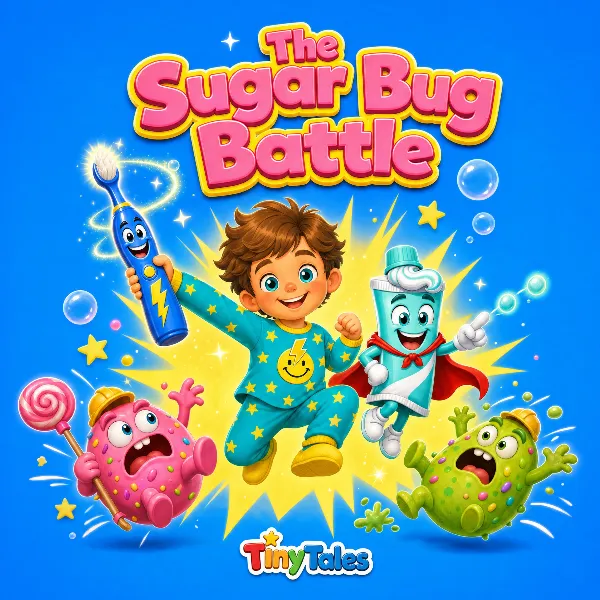
A particularly effective frame — and the one behind our own book — is the "sugar bugs" story: the idea that tiny bugs settle on teeth after eating, and brushing is how you chase them away. It gives the child a visible enemy, a mission, and a clear win, all inside something they'd have to do anyway. Kids who won't brush because a parent said so will often brush to "get the sugar bugs" — same toothbrush, completely different framing.
The catch with an off-the-shelf book is that the hero is always someone else. Your child roots for a cartoon animal or a generic kid, watches them win the brushing battle, and then still has to be talked into their own. The story lands one step removed from the actual toothbrush in your hand.
Where personalization changes the math
This is where a personalized book earns its (higher) price — and where honesty matters most.
When the hero of the story is your child — same name, and in a photo-real book, the same face — the reframe stops being about a character on the page and becomes about them. It's no longer "watch this bunny brush." It's "it's your turn to fight the sugar bugs." For a child whose resistance is really about control, being the star who chooses to brush is a fundamentally different proposition than being the toddler who's told to.
Our own version, The Sugar Bug Battle, leans into this on purpose. The child becomes the hero of the brushing adventure, and because it's a choose-your-own-adventure story, they make the choice to brush inside the story rather than having it imposed. That small shift — deciding to be brave and brush, instead of being ordered to — is the same lever that helps with other daily standoffs like bedtime. The child practices the decision in a low-stakes story, then carries a little of that agency to the real sink.
Here's the honest part: none of this is guaranteed to work on your particular child, and a book is one small input into a habit that's built by repetition and your presence at the sink. Personalization raises the odds a child leans in; it doesn't override a toddler having a bad night. Anyone selling it as a cure is overselling.
Personalized vs. regular vs. name-insertion — an honest comparison
There are three real options, and the best one genuinely depends on your child's age and how much the brushing fight is actually costing you.
Classic non-personalized picture books. There are lovely, effective, inexpensive teeth-brushing books — board books built for the 2-to-4 crowd with rhythm, repetition, and bright art (Douglas Florian's Brush! Brush! Brush! is a well-loved example, and there are many others). For a young toddler who just needs the idea of brushing made fun and familiar, these are often all you need, and they cost a few dollars. Don't overspend if a $6 board book does the job.
Name-insertion personalized books. A step up in engagement: the child's name is printed into the story text and sometimes the art. As of July 2026, options like MyCreateABook's "Brush Your Teeth Please" (about $13) put the child's name through the story and add a sticker reward-chart element and a photo sticker. These are charming, gentle, and affordable, and the name alone is enough to make many young children pay closer attention. If your child is on the younger end and the fight is mild, this is a sweet, low-cost middle ground.
Photo-real personalized books. The high end. Using one uploaded photo, a book like TinyTales makes the child genuinely appear as the hero of the story — not a name dropped into someone else's illustration, and not cartoonified. It's the most expensive of the three, and it's overkill for a toddler who already brushes happily. Where it earns its price is the 3-to-6-year-old who negotiates — where seeing their own face winning the brushing battle, and choosing to brush inside a branching story, is worth more than a name in the text. As of July 2026, the major personalized-book brands don't offer a dedicated teeth-brushing title, so the photo-real, problem-specific version is genuinely uncommon.
Notice there's no universal winner. The right choice is a match between your child's age, how stubborn the brushing fight really is, and your budget. A cheaper option that your child actually engages with beats an expensive one that sits on the shelf.
How to actually use a teeth-brushing book
Whatever you buy, the book is a tool inside a routine — it works far better with a few habits around it.
- Read it away from the sink first. Introduce the story at a calm moment — on the couch, not with a toothbrush already in your hand. Let the child fall in love with the hero before there's any pressure to perform.
- Make the book part of the routine, not a bribe. "First the sugar-bug story, then we go brush" builds a predictable chain. Bribing ("if you brush, I'll read it") teaches the child that brushing is a cost to be compensated.
- Keep supervising. The AAPD is clear that young kids can't brush effectively alone. The book gets them to the sink willingly; you still do the actual brushing with them until they're older.
- Let them be the hero out loud. If the book stars your child, say their name as the one beating the sugar bugs. The point is to transfer the story's agency to the real moment.
- Don't expect a straight line. Some days the story works like magic and some days nothing does. Consistency, not perfection, is what builds the habit.
The honest bottom line
A book will not make your child brush their teeth. A twice-a-day supervised routine will, over time — that's the part the dentists are unanimous about. What a good teeth-brushing book does is make the start of that routine easier: it turns a boring, slightly invasive chore into a story where your child is the hero who chooses to win.
For the youngest kids, or a mild fight, a cheap board book or a name-insertion story is often plenty. For a 3-to-6-year-old who has turned brushing into a nightly standoff, a personalized book — where they see themselves choosing to be brave and defeat the sugar bugs — can be the thing that finally shifts "no" to "my turn."
If that's the fight you're in, The Sugar Bug Battle was built for exactly it — and you can see how the personalization works, or browse the full collection of stories, before deciding whether it's worth it for your child. Just keep the expectation honest: the book gets them to the sink. The routine, and you, do the rest.
See your child in the story
Upload one photo and see The Sugar Bug Battle with their real face in the pictures, before you pay.
Preview their book freeFrequently asked questions
Can a book really get my toddler to brush their teeth?
Not on its own — and any product that promises to is overselling. What a good teeth-brushing book does is make the habit feel like a story instead of a chore, and give an otherwise boring two minutes a character, a reason, and a little suspense. The habit still comes from doing it every morning and night with you standing there; the book just lowers the resistance at the start. Pair it with a consistent routine and supervision, which is what dentists actually recommend.
Why would a personalized teeth-brushing book work better than a regular one?
Two reasons. Children identify most strongly with a hero who looks and is named like them, so a book where your child is the one fighting the sugar bugs turns 'go brush' into 'it's my turn to be the hero.' And a brushing battle is usually a small control standoff — a story where the child makes the choice to brush (rather than being told to) hands a little of that control back. A regular book can still be wonderful; personalization just raises the odds your particular child leans in.
What age is a teeth-brushing book good for?
Roughly ages 2 to 6, which is exactly when brushing resistance peaks and a child is old enough to recognize themselves as the hero. For babies and the youngest toddlers, a short rhyming board book is often the better and cheaper fit. Around 3 to 6 — when kids stall, negotiate, and clamp their mouths shut — a story where they willingly defeat the 'sugar bugs' does more.
What do dentists actually say about when and how to brush?
The American Academy of Pediatric Dentistry recommends brushing twice a day as soon as the first tooth appears, using a tiny smear of fluoride toothpaste under age 3 and a pea-sized amount from ages 3 to 6, with an adult supervising because young children can't brush effectively on their own. They also recommend a first dental visit when the first tooth appears or by the first birthday. A book supports that routine; it doesn't replace it.
How is a photo-real personalized book different from a name-in-the-story one?
Name-insertion books print your child's name into the text and sometimes the art; they're charming, gentle, and usually the most affordable choice. A photo-real book like TinyTales uses one uploaded photo to make the child genuinely appear as the hero in every scene, not cartoonified. The honest trade-off: name-insertion is cheaper and lovely for the youngest kids; the photo-real version wins when you want your child to actually see themselves winning the brushing battle.